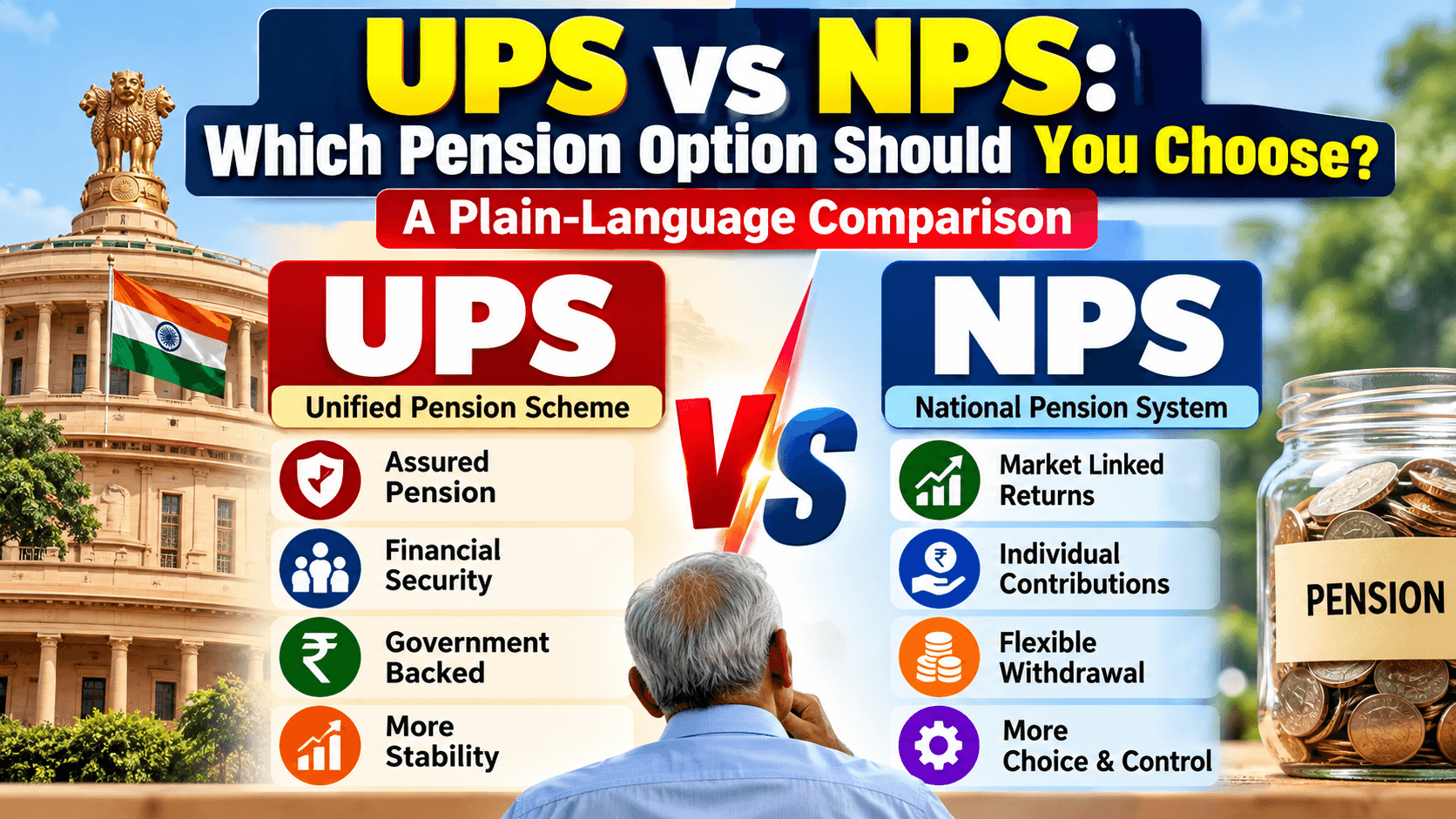
UPS vs NPS: Which Pension Option Should You Choose? A Plain-Language Comparison
- Date of Posting
- 27 September 2026
- Applies to
- All states
NPS (National Pension System) | UPS (Unified Pension Scheme) | |
|---|---|---|
Type of benefit | Market-linked — final amount depends on investment performance | Assured, defined pension — fixed amount regardless of market |
Employee contribution | 10% of Basic Pay + DA | 10% of Basic Pay + DA (same rate) |
Government contribution | 14% of Basic Pay + DA | 10% matching (individual corpus) + ~8.5% additional (pooled corpus) = ~18.5% total |
How the payout works | Corpus + investment returns; a portion goes into a purchased annuity that pays you monthly | Direct formula: 50% of average basic pay over the last 12 months, after 25+ years of service |
Minimum service for any pension | Standard NPS withdrawal norms | 10 years — below that, no assured pension |
Between 10 and 25 years of service | Standard NPS rules | Pro-rata pension, guaranteed floor of ₹10,000/month |
Family pension | Standard NPS provisions | 60% of the pension the employee was entitled to |
Choice of investment | You choose fund manager and asset allocation | None — fixed formula, no managed portfolio |
Switching schemes | — | One-time, one-way switch from UPS to NPS only — at least 1 year before superannuation, or 3 months before VRS. Cannot switch back to UPS afterward |
Original NPS→UPS choice | — | Final and irrevocable once opted in |
Voluntary Retirement (VRS): the difference that catches people off guard
This is one of the least understood parts of choosing between these two schemes — the eligibility age is similar, but when your money actually arrives is very different.
Under NPS: if you take VRS after 20 years of service, you continue receiving the same benefits as a regular retirement — the standard NPS withdrawal/annuity process applies right away.
Under UPS: you can take VRS after 20 years of service, but:
The assured payout is only available on a pro-rata basis at 20-24 years (years of service ÷ 25, applied to the full assured payout amount)
You only get the full 50%-of-basic-pay payout if you complete 25 years
Critically: even if you take VRS at 25+ years, your monthly assured payout does NOT start immediately. It only begins from the date you would have reached normal superannuation age (60) — not from the day you actually leave service. You can, however, take your lump sum and final withdrawal amount immediately at the time of VRS itself.
What this means practically: if you're planning early retirement specifically to start drawing a pension right away, UPS's VRS route will not give you that — there could be a gap of many years between when you leave and when the monthly assured payout actually begins. NPS's VRS route doesn't have this delay. If immediate income after early retirement matters to you, this is a significant factor to weigh.
What this actually means for you overall
NPS suits you if: you're earlier in your career, comfortable with market risk, want investment control, and value that VRS benefits start immediately rather than being deferred to age 60.
UPS suits you if: predictability matters more than upside, you're confident you'll reach 25+ years of continuous service (not early VRS), and you'd rather the government absorb investment risk — understanding that the ~18.5% government contribution funds a guarantee you can only fully access by staying until near-normal retirement age.
The 10-year floor and the VRS payout delay are the two details most likely to surprise people who assume UPS is simply "NPS but safer" — it's safer in outcome, but comes with real timing constraints NPS doesn't have.
Note specific to Railway employees: your department's circular (RBE No. 75/2026) also states that resigning (as opposed to retiring or taking VRS) forfeits the UPS assured payout entirely — only your accumulated individual corpus is then handled per regulations. Verify this with your department's pension cell for your specific case.
Before you decide: This is a significant, largely irreversible financial choice with real timing implications. Read the [full RBE No. 75/2026 circular](link to your own post) in full, and consult your department's pension cell before deciding — this piece explains the shape of the choice, not a substitute for official guidance.
That VRS-timing detail is genuinely the most valuable addition here — it's the kind of thing that could catch a reader completely off guard if they assumed VRS meant "immediate pension" under UPS the same way it does under NPS.
नई खबरें सीधे अपने फोन पर
DA, वेतन आयोग, पेंशन और नए सर्कुलर की जानकारी पाने के लिए हमारा Telegram या WhatsApp चैनल जॉइन करें, या अलर्ट चालू करें। Get new circulars and updates on your phone.
Read more
6% सालाना इंक्रीमेंट की मांग: आपकी बेसिक पे पर 20 साल में कितना असर, जानिए पूरा गणित
27 Oct 2026
8वां वेतन आयोग: अब तक क्या तय हुआ, क्या बाकी है? Fitment Factor से समझें आपकी संभावित नई Basic Pay
26 Oct 2026
GDCE की पूरी जानकारी: मार्च 2028 तक रेलवे कर्मचारियों को Promotion पाने का मौका, जानें Eligibility और Exam Rules
25 Oct 2026
क्या पिछले वेतन आयोगों में निचले स्तर के कर्मचारियों की आवाज कमजोर रही? जानिए वो विवाद जिससे उठा बड़ा सवाल!
23 Oct 2026